

Motorway driving rules: what you can and cannot do
Motorways are statistically the safest roads, but they have firm rules. Keep to the left unless overtaking, never use the hard shoulder except in an emergency, and obey the signs on smart motorways, where a red X and a red-circle speed limit are both legally enforced by camera.

Earn points and use them to save money in the app. Download today.


What are the rules for motorway lane discipline?
The basic rule is to keep to the left-hand lane unless you are overtaking. The middle and right-hand lanes are for passing slower traffic, and you should move back to the left once you have completed the manoeuvre.
The left lane is not the "slow lane"; it is the normal driving lane for all vehicles. Overtaking on the left, known as undertaking, is not allowed except in slow-moving queues where lanes are moving at different speeds. Good lane discipline keeps traffic flowing and is the foundation of safe motorway driving.
Motorway signs and markings matter too, and UK road signs explained covers them.
Lane discipline and following distance are closely linked on high-speed roads - our guide to tailgating laws and fines explains what counts as a dangerous gap and the penalties for careless driving on the motorway.
What is middle lane hogging and is it illegal?
Middle lane hogging is staying in the middle lane when the left lane is clear. It forces other drivers to move across two lanes to overtake and reduces the road's capacity.
It is illegal. Since 2013 it has been treated as careless driving, and police can issue a fixed penalty of £100 and 3 points for it. Many drivers do not realise it is an offence rather than just bad manners, but it carries the same penalty as other forms of inconsiderate driving.
Lane discipline on a motorway becomes especially important when emergency vehicles are involved, and our guide to emergency vehicle rules explains the safest response and the specific situations where drivers face fines despite trying to help.
Middle lane hogging is one of the most frequently reported motorway offences - our guide to the rules on middle lane hogging explains when it becomes a fixed penalty offence and what lane discipline actually requires.
What are smart motorway rules?
Smart motorways use technology and overhead signs to manage traffic, and on many stretches the hard shoulder has been converted into a permanent running lane. Two signals carry legal force. A red X above a lane means that lane is closed, and driving in it is an offence carrying £100 and 3 points. A speed limit shown in a red circle is mandatory and enforced by camera.
Following the cancellation of new smart motorway construction in 2023, no further schemes are being built, but the existing network remains in use, so the rules still apply.
Smart motorways rely on overhead cameras, and our guide to UK speed cameras covers HADECS and the rest.
Smart motorways are part of the same infrastructure being evaluated for autonomous vehicle operation - our data piece on the driverless taxi rollout in the UK covers which cities have active trials, what the vehicles look like, and the regulatory timeline.
The rules differ significantly on smart motorway sections, and our guide to hard shoulder rules on smart motorways explains emergency refuge areas, the red X sign, and what to do if you cannot reach one.
What do you do if you break down on a motorway?
If you can, leave at the next exit or pull into a service area. If you cannot, move onto the hard shoulder or into an emergency area, stop as far to the left as possible, and angle your wheels to the left. Switch on your hazard lights.
Get everyone out of the left-hand doors and behind the safety barrier, away from the carriageway, and keep pets in the car. Call for help using your phone or the orange roadside emergency telephones, which connect to a control room and pinpoint your location. Do not attempt repairs yourself.
Long motorway drives make fatigue a real risk, and whether it is illegal to drive tired explains where the law stands.
Heat adds a further layer of risk on long motorway journeys - more traffic from train cancellations, exposed bridges, and higher breakdown rates - and our guide to driving in hot weather explains what to expect.
Can you stop on a motorway hard shoulder?
Only in an emergency. On a conventional motorway the hard shoulder is for genuine emergencies and breakdowns, not for taking a phone call, checking directions or having a rest. Stopping there without good reason is an offence.
On a smart motorway with all-lane running, there is no permanent hard shoulder at all. If a lane is open, it is a live running lane. You must reach an emergency area or leave the motorway, which is why these stretches have orange refuge areas at intervals.
Dual carriageways share some features with motorways but have their own distinct rules - our guide to dual carriageways covers the speed limits, lane rules, and how to join and leave safely.
Planned rest stops at motorway services are far safer than relying on the hard shoulder - our guide to the best motorway services in the UK covers the top-rated stops across the network so you can plan breaks in advance.
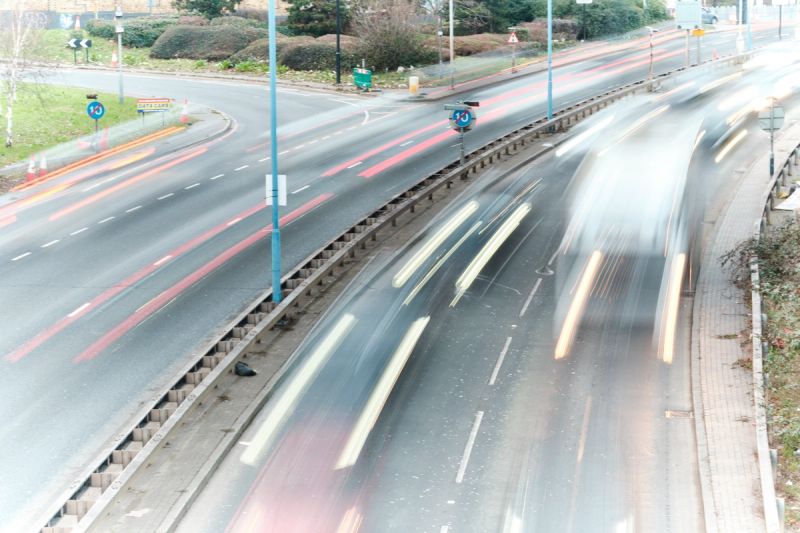
What are the rules on motorway speed limits?
The national speed limit on a motorway is 70mph for cars and motorcycles. Lower limits apply to certain vehicles: cars towing a trailer or caravan, and goods vehicles, are limited to 60mph.
On smart motorways the limit can be varied below 70mph to manage congestion, shown in a red circle on the overhead gantries. Those variable limits are legally binding and enforced by HADECS cameras. When no limit is displayed, the national limit applies.
Exceeding a motorway limit is treated seriously, and our guide to speeding fines explains the penalties.
Knowing the routes helps too, and our guide to the UK's biggest motorways covers which ones carry the most traffic and where they run.
Variable speed limits and lane closures are also triggered by high winds on exposed motorway stretches, and our guide to driving in high winds explains which bridges and routes are most affected and what to do when conditions worsen en route.
The safety record of motorways is better than most drivers assume - UK road accident statistics show motorways account for just 6% of fatalities despite carrying 21% of all traffic, making them five times safer per mile than rural roads.
Can learner drivers use motorways?
Yes, in England, Scotland and Wales, but only with an approved driving instructor in a car fitted with dual controls. This has been allowed since June 2018. A parent, friend or other supervising driver does not qualify, however experienced.
Motorway lessons are voluntary and not part of the practical test. Our guide for learners on motorway driving explains how those lessons work and what to expect.
For any motorway journey in a borrowed or temporary vehicle, temporary car insurance gives you your own cover for the trip without going on the owner's policy.
What are the rules for joining and leaving a motorway?
Joining safely is about matching speed. Use the slip road to build up to the speed of the traffic already on the motorway, give way to it, and merge into a suitable gap without forcing other drivers to brake or swerve. Do not stop on the slip road unless the traffic ahead has stopped.
When leaving, move into the left-hand lane in good time, watch for the countdown markers that show the distance to the exit, and do most of your slowing on the slip road rather than the carriageway. After a long motorway stretch your sense of speed adjusts, so check your speedometer on the slip road, where limits are much lower and often camera-enforced.
The rules change significantly on single carriageways, and our guide to single carriageway driving covers the limits and overtaking.
Merging is not limited to slip roads - our guide to merging in turn at roadworks and lane closures explains the Highway Code rule most drivers have never heard of.
Is there a minimum speed on a motorway?
There is no general minimum speed limit on a motorway, but driving unnecessarily slowly can be dangerous and can amount to careless driving if it obstructs other traffic. On rare occasions a temporary minimum speed may be signed, shown as a blue circle.
The practical guidance is to keep up with the safe flow of traffic. Driving far below the prevailing speed, or hesitating when joining, creates as much risk as driving too fast, so build up to traffic speed on the slip road before merging.
Frequently asked questions
Is middle lane hogging illegal in the UK?
Yes. Since 2013 it has been treated as careless driving, and police can issue a fixed penalty of £100 and 3 points. You should return to the left-hand lane once you have finished overtaking rather than sitting in the middle lane.
What should you do if you break down on a smart motorway with no hard shoulder?
Aim for an orange emergency area or leave at the next exit. If you cannot, stop as far left as possible with hazard lights on, get everyone out and behind the barrier where possible, and call for help. Operators can close the lane with a red X remotely.
When can you use the hard shoulder legally?
On a conventional motorway, only in a genuine emergency or breakdown, never to rest or take a call. On a smart motorway with all-lane running there is no permanent hard shoulder; an open lane is a live running lane, so use an emergency area instead.
Is there a minimum speed limit on motorways?
There is no general minimum, but driving unnecessarily slowly can obstruct traffic and amount to careless driving. A temporary minimum can occasionally be signed in a blue circle. The safe approach is to keep up with the prevailing flow of traffic.
Can newly qualified drivers use the motorway straight away?
Yes. Once you pass your practical test you can drive on motorways unaccompanied immediately. Many new drivers take a voluntary motorway lesson or a Pass Plus course first to build confidence before driving on one alone.
Temporary insurance quote
Get a price in under 60 seconds!