
UK road accident statistics: 1,602 deaths and the patterns behind them
1,602 people were killed on Great Britain's roads in 2024. A further 29,467 were seriously injured. The data that sits behind those numbers - collected via the STATS19 system and published annually by the Department for Transport - reveals consistent patterns in where, when, and to whom road casualties happen. The findings challenge some assumptions about which roads are actually the most dangerous.
- 1,602 Road deaths in Great Britain in 2024
- 128,272 Total road casualties in 2024
- 60% Of deaths happen on rural roads
- 76% Of road fatalities are male
About the data
The figures on this page come from the Department for Transport's annual Reported Road Casualties Great Britain report for 2024, based on STATS19 data - the system used by all UK police forces to record personal injury road collisions. The data covers England, Scotland, and Wales only; Northern Ireland is reported separately and recorded an additional 69 road deaths in 2024.
Only collisions that result in personal injury and are reported to the police are included. Unreported incidents are not counted. The 2024 total of 1,602 deaths represents a 5% fall from 2023 and continues a long-term downward trend - road deaths have fallen by 34% over the past decade, against a 2% rise in total vehicle miles travelled.
Rural roads are by far the most dangerous
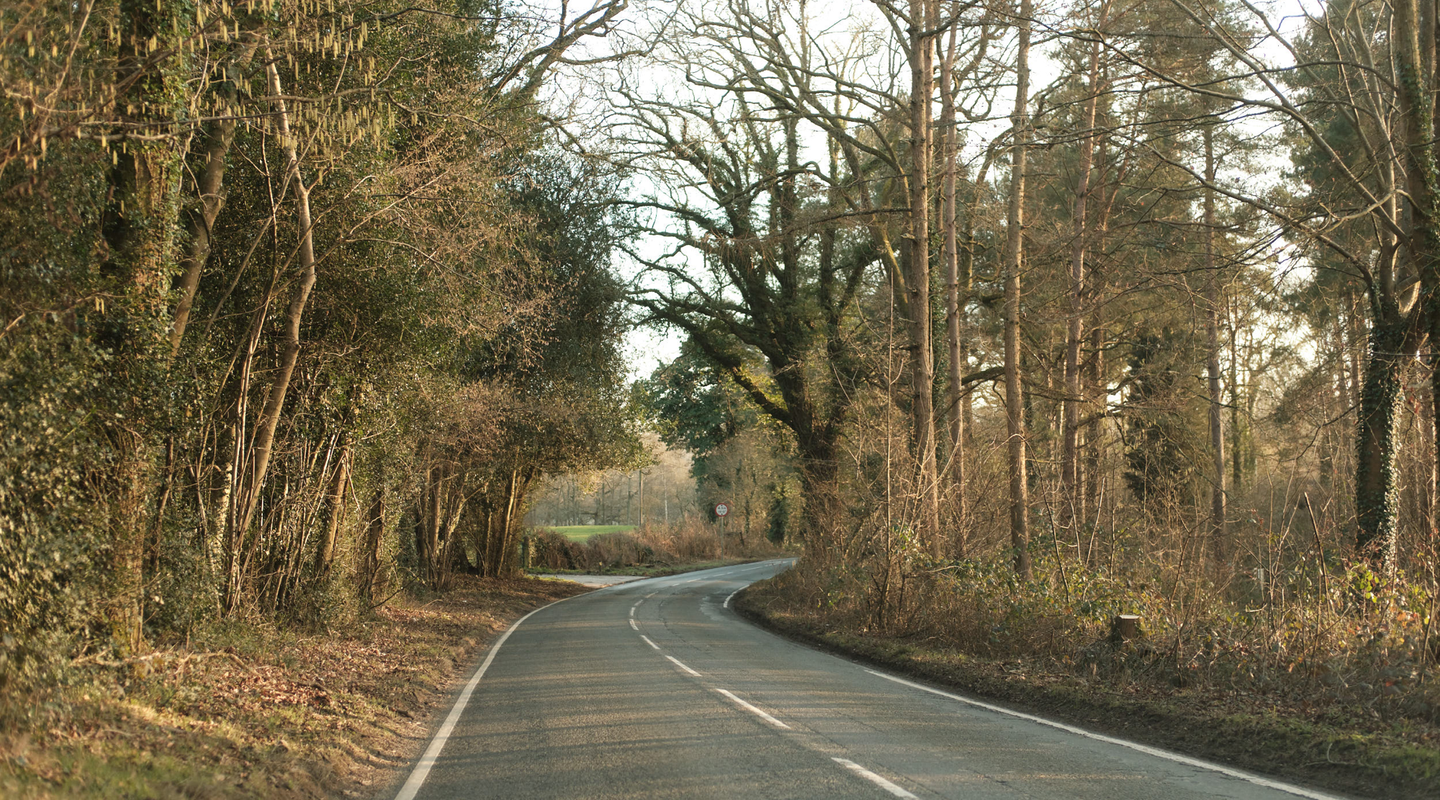
The most striking finding in the STATS19 data is the disproportionate share of deaths that occur on rural roads. Rural roads accounted for 60% of all road fatalities in 2024 - 956 deaths - while carrying only 45% of total traffic. Motorways, by contrast, carried 21% of all traffic but accounted for just 6% of fatalities.
When adjusted for the amount of traffic each road type carries, rural roads are approximately five times more dangerous per mile than motorways. This runs counter to how many drivers think about road risk. Motorways feel fast and exposed, but their controlled access, central reservation, hard shoulder, and consistent design make them far safer per mile than a winding single-track lane with no markings.
The reason rural roads claim so many lives is the severity of impacts rather than the frequency of collisions. High speeds combined with oncoming traffic, narrow widths, unlit conditions, and fewer safety barriers mean that when a rural collision happens, it is more likely to be fatal.
Rural roads carry particular risks, including livestock and wildlife, and our guide to animal road signs explains what to watch for.
Share of road fatalities by road type (2024)
Rural roads carry 45% of traffic but account for 60% of deaths. Motorways carry 21% of traffic but account for just 6%.
- Rural roads
- Urban roads
- Motorways
DfT: Reported Road Casualties Great Britain, annual report 2024. Data covers England, Scotland, and Wales only.
Motorways vs rural roads: the traffic-adjusted risk gap
- Motorways 6% of fatalities - carrying 21% of all traffic
- Rural roads 60% of fatalities - carrying 45% of all traffic
DfT: Reported Road Casualties Great Britain, annual report 2024. Data covers England, Scotland, and Wales only.
Who is most at risk on the road
Car occupants account for the largest share of road deaths at 43% (692 deaths in 2024), reflecting the volume of car travel. But looked at by exposure, pedestrians and motorcyclists are significantly over-represented. Pedestrians made up 25% of deaths (409) and cyclists 5% (82) despite accounting for a far smaller share of vehicle miles.
Gender is the most consistent demographic factor in the data. 76% of all road fatalities in 2024 were male. That pattern holds across nearly every road user type and age group. Among drivers, males aged 17-29 account for around 22% of all road deaths despite holding a much smaller share of licence years.
Drivers aged 17-24 represent approximately 7% of all licence holders but are involved in around 20% of fatal and serious crashes. The combination of inexperience, higher risk tolerance, and higher rates of late-night driving on unfamiliar rural roads is well-documented in the research.
For drivers who want flexible cover in place for any vehicle they use, temporary car insurance offers comprehensive daily or weekly protection with no annual commitment required.
Road fatalities by road user type (2024)
Percentages of 1,602 total fatalities in Great Britain in 2024.
- Car occupants 43%
- Pedestrians 25%
- Motorcyclists 21%
- Pedal cyclists 5%
- Other 6%
DfT: Reported Road Casualties Great Britain, annual report 2024. Data covers England, Scotland, and Wales only.
The main causes of fatal crashes
The STATS19 system records contributory factors for each collision, and the 2024 data shows three factors appearing in the majority of fatal crashes. Failing to look properly was recorded in 38% of all collisions, making it the most common single factor across all severity levels.
For fatal crashes specifically, speed - either exceeding the limit or travelling too fast for conditions - was a factor in up to 29% of incidents. Driver distraction, including mobile phone use, was recorded in approximately 15% of collisions. Drink-driving casualties (killed or seriously injured) totalled 1,860 in 2023, the most recent year for which a full breakdown is available.
Poor weather and road conditions, often assumed to be a major factor, account for around 9% of collisions - significant but well below the human behaviour factors at the top of the list.
Road condition is a contributing factor worth its own look, and our pothole statistics breaks down the scale of the problem and the cost to drivers.
Top contributory factors in UK road collisions (2024)
Factors are not mutually exclusive - multiple factors can be recorded per collision.
- Failing to look properly 38%
- Speeding or too fast for conditions 29%
- Driver distraction 15%
- Careless or reckless driving 12%
- Poor weather or road conditions 9%
DfT: Reported Road Casualties Great Britain, annual report 2024. Data covers England, Scotland, and Wales only.
Young drivers and the risk in context
The data on young drivers reflects a genuine statistical risk, not a stereotype. Drivers aged 17-24 are disproportionately involved in serious crashes for several well-understood reasons: less experience of hazard recognition, higher rates of driving at night and on rural roads, and a lower baseline of automatic driving behaviour that leaves less mental capacity for scanning the road environment.
That risk profile is also why insurance premiums for new and young drivers are significantly higher than for experienced drivers. Car insurance after passing your driving test explains what to expect from first-policy pricing and how a telematics policy can reduce the cost by building a safety record.
For learners still building experience before their test, learner driver insurance on a parent's car allows practice to happen in a real vehicle and on real roads - which is exactly the type of exposure the data shows makes the biggest difference to long-term safety.
How Great Britain compares internationally
Great Britain ranked fourth out of 36 countries for road safety in 2024 based on fatalities per million population, with 24 deaths per million. Norway (16) and Sweden (20) lead the table. France records 44 deaths per million and the United States 128.
The long-term trend in Great Britain is positive - road deaths have fallen by 34% over the past decade against rising traffic volumes. But the rate of improvement has slowed. Deaths were broadly flat at around 1,700 per year from 2020 to 2023 before falling 5% in 2024. Rural road deaths, which remain the dominant category, have not seen the same improvement as urban fatalities, where engineering interventions like 20mph zones and better pedestrian infrastructure have had a measurable impact.
New driver? Get covered from day one
Whether you have just passed your test or want to practise in a family member's car, Covertime provides short-term cover that does not touch an existing annual policy.
Get a price in under 60 seconds!
