
The UK driving test explained
The UK practical driving test is a 40-minute on-road assessment of whether you can drive safely and independently. It is not a test of perfection - minor faults are expected. The examiner is assessing whether you can manage real traffic situations without creating danger. Here is how the whole test works, stage by stage.

Earn points and use them to save money in the app. Download today.


What does the driving test involve?
The test has four main parts: an eyesight check, vehicle safety questions, around 40 minutes of driving, and a result debrief. The driving section includes general road driving across different road types, around 20 minutes of independent driving, at least one manoeuvre, and a possible emergency stop.
The test is the same standard across all DVSA test centres in England, Scotland, and Wales. The examiner uses a standardised marking sheet and applies the same criteria regardless of which centre you use.
Knowing how long each part takes helps you plan the day and manage nerves - our guide to how long the driving test takes breaks down the duration of each section from the eyesight check to the debrief.
The test itself gives no guidance on lesson count - but understanding the format helps you target your practice more effectively - how many driving lessons does the average UK learner need covers the DVSA's published average, what affects the number, and when learners are typically ready to book the test.
The eyesight check and safety questions
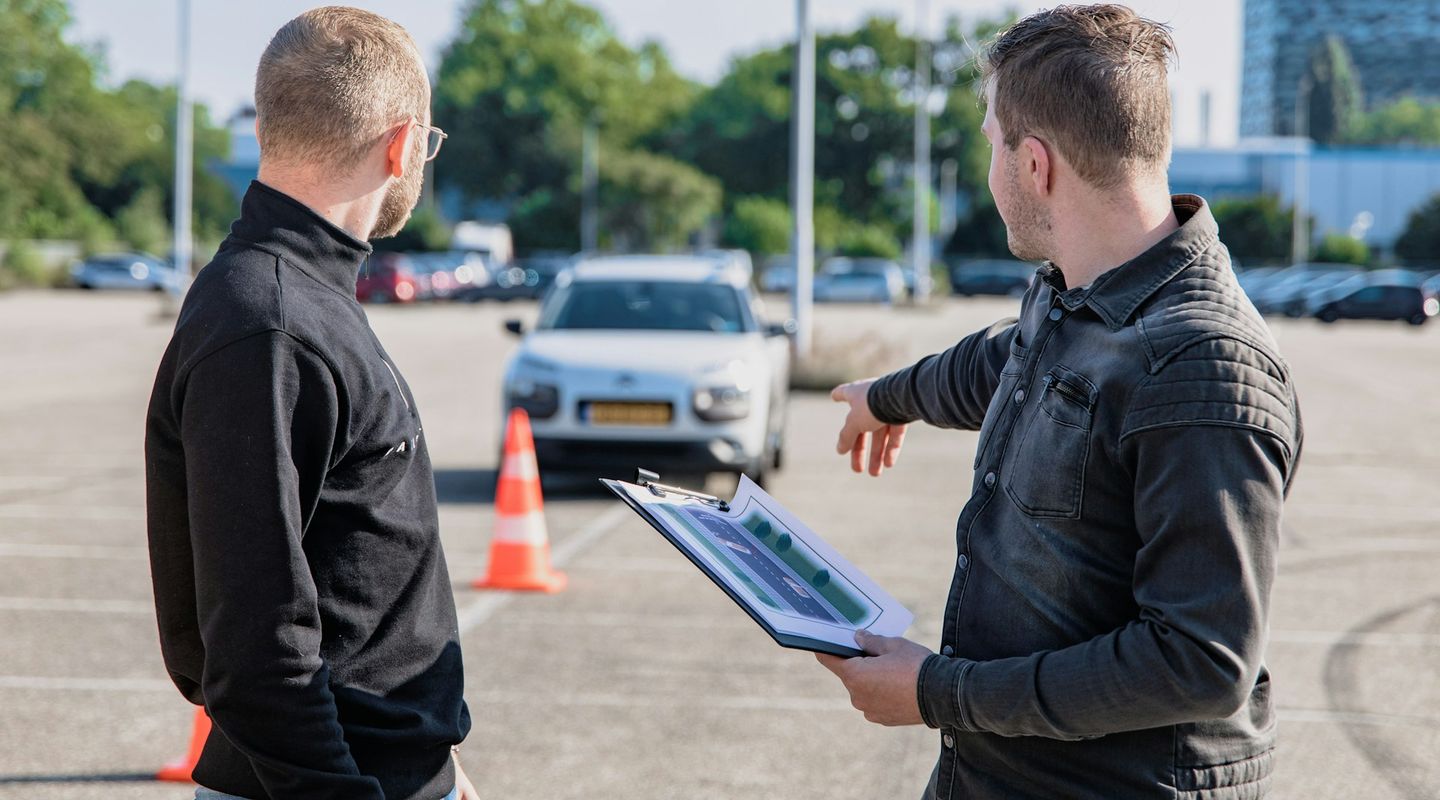
The test begins in the car park with an eyesight check. You read a standard number plate at 20 metres. If you fail the eyesight check, the test ends immediately and is recorded as a fail. Bring glasses or contact lenses if you need them for driving.
The examiner then asks a "tell me" vehicle safety question - a verbal question about how to check or operate something on the car, such as how to check tyre pressure. A "show me" question is asked while driving - for example, operating the rear demister. One minor fault is recorded if you answer either question incorrectly. Answering both incorrectly still counts as one minor, not two.
Reversing manoeuvres are among the most common reasons for test failures - our guide to reversing manoeuvres on the driving test covers the three that could be tested and the fault types examiners look for.
Pass Plus is available immediately after passing the standard test and is designed to fill the gaps the test does not cover - what is Pass Plus and how does it work explains the six-module structure, what is covered in each session, and how it compares to telematics for reducing new driver premiums.
How the examiner marks you
Three fault categories are used. A dangerous fault - where the examiner intervenes or another road user is put at risk - means an immediate fail. A serious fault - a significant error in safety, control, or judgment - is also an automatic fail. A minor fault is a small error that does not endanger anyone.
You can accumulate up to 15 minor faults and still pass. Reaching 16 is a fail. Repeating the same minor in the same type of situation can be upgraded to a serious fault. The examiner records every fault with a code that identifies both the error type and where it occurred.
You will need specific documents before you can be admitted to the test - our checklist of what to bring to the driving test covers your provisional licence, theory test certificate and what happens if you forget anything.
Private practice alongside formal lessons uses learner driver insurance, which covers each session in a parent's or friend's car without affecting their no-claims discount.
The independent driving section
Roughly 20 minutes of the drive is spent on independent driving. You follow a sat nav (provided by the examiner) or road signs, depending on the route. Navigation is not what is being assessed - the examiner is watching how safely you drive while managing your own route.
Missing a turning is not a fault. Braking sharply while looking at the sat nav, or cutting a corner to recover from a wrong turning, would be. If you genuinely lose track of where to go, pull over safely and ask for direction - this is not penalised.
Most learner drivers find the independent section easier than they expect. Because the examiner is quiet and you are focused on the route, the time passes quickly. The key is to keep your normal observation routine rather than letting concentration on the sat nav break your scanning habits.
The independent driving section is the longest and most misunderstood part of the test - our full guide to independent driving on the test explains what sat-nav routes and traffic-sign navigation involve in practice.
Manoeuvres
One manoeuvre is selected by the examiner: parallel parking, pulling up on the right and reversing, forward bay parking and reversing out, or reverse bay parking. You will not know which one in advance. Each is assessed on accuracy, control, and observation of other road users.
An emergency stop may be requested on around one in three tests. The examiner signals while you are driving and you must stop promptly and under control. Locked wheels are not penalised on modern cars with ABS; the key assessment is speed of reaction and steering control after stopping.
Practise all four manoeuvres before your test even if you feel confident about specific ones - the examiner's choice is not disclosed in advance and cannot be influenced by your preferences.
The emergency stop is one of only three manoeuvres that might be called during the test - our guide to the emergency stop on the driving test covers what the examiner looks for and the correct technique.
What happens if you pass?
The examiner hands you a pass certificate and explains how to upgrade your provisional to a full driving licence via the DVLA. You can drive home on the certificate immediately - you do not need to wait for the physical licence to arrive.
Check your insurance before driving away. Your insurance position changes the moment you pass - learner policies end at that point, and driving on without valid insurance even briefly creates a risk.
What happens if you fail?
The examiner provides a written fault report that lists each fault, its category, and the situation in which it occurred. You can rebook immediately but must wait at least 10 working days between tests.
The fault report is more useful than a general debrief. It tells you exactly where on the route and in what situation each fault occurred. Most instructors review the report and focus subsequent lessons on the specific scenarios rather than general practice.
Driving with a provisional licence has its own rules about supervision and where you can practise - worth reviewing if you need more time on particular road types before reattempting.
Frequently asked questions
How many minor faults can you get and still pass?
Up to 15. Reaching 16 minor faults fails the test. Repeating the same minor fault in the same type of situation can also be upgraded to a serious fault, which is an automatic fail.
What is a serious fault in the driving test?
A significant error in safety, control, or judgment - for example, pulling out without adequate clearance or failing to react to a pedestrian stepping into the road. One serious fault fails the test.
Do you have to do a parallel park in the driving test?
Not necessarily. The examiner selects one manoeuvre from four options: parallel parking, pulling up on the right and reversing, forward bay parking and reversing out, or reverse bay parking. You do not know in advance which one will be requested.
Can you talk to the examiner during the test?
Yes. The examiner asks the show me safety question during the drive and gives directions outside the independent section. You can ask for clarification if you did not hear a direction. Normal conversation is not expected.
What happens to your provisional licence when you pass?
You can drive on your pass certificate for up to two years. Apply online via the DVLA to receive your full photocard licence - it typically arrives within about a week.
Temporary insurance quote
Get a price in under 60 seconds!