
Child car seat laws in the UK: what is required and when
Children must use an appropriate car seat until they reach 135cm tall or their 12th birthday, whichever comes first. After that they use an adult seatbelt. The driver is responsible for any child under 14 in the car, and using the wrong restraint can mean a fine of up to £500.

Earn points and use them to save money in the app. Download today.


What are the child car seat laws in the UK?
The law requires children to travel in an approved child car seat suited to their height or weight until they are either 135cm tall or 12 years old, whichever they reach first. Only after that point may they use an adult seatbelt alone.
The seat must be correctly fitted and approved to a recognised standard. The driver is legally responsible for making sure every child under 14 in the vehicle is using the correct restraint, so the duty sits with whoever is driving, not with the child or the parent in the passenger seat.
Driver responsibility extends further than many people realise - our guide to driving laws you might not know you are breaking covers the everyday habits that are technically illegal and the penalties they carry.
What car seat does a child need by age and height?
Modern seats are chosen by height under the i-Size standard, while older seats are grouped by weight. Both systems are currently legal, which is why you will still see seats labelled Group 0, 1, 2 and 3 alongside newer height-based ones.
Broadly, babies start in a rear-facing seat, move to a forward-facing seat as they grow, and later to a high-backed booster that positions the adult belt correctly. The crucial point is to follow the manufacturer's height and weight range for the specific seat, as that, not age alone, determines what your child needs.
Driver responsibility extends to phone use on every journey - our guide to mobile phone driving law covers what counts as using a phone, the hands-free rules, and the new AI enforcement cameras.
When can a child use a seatbelt without a car seat?
A child can use an adult seatbelt without a car seat once they are 135cm tall or have turned 12, whichever comes first. Below that, they need the appropriate seat even if they seem big enough.
The reason is that an adult belt is designed for an adult frame. On a smaller child it can sit across the neck or stomach rather than the shoulder and hips, which can cause serious injury in a crash. A high-backed booster raises the child so the belt sits correctly, which is why boosters matter right up to the height threshold.
Adult seatbelt rules have their own set of exemptions and responsibilities - our guide to UK seatbelt law covers who is legally responsible for each passenger and when exemptions apply.
What are the rules for taxis and private hire vehicles?
There is an exception for licensed taxis and private hire vehicles. If the correct child seat is not available, a child aged 3 or over may travel using the adult seatbelt in the rear. A child under 3 may travel without a seat in the rear of a licensed taxi or minicab, but only if no child seat is available.
This exception exists for practical reasons, not because it is the safest option. Where you can provide or bring a suitable seat, you should, as the protection it offers does not change just because the journey is in a taxi.
The requirement to properly restrain occupants extends to animals - our guide to pets in cars and UK law explains what the Highway Code says and how to avoid a fine.
What happens in an emergency without a car seat?
The law allows limited flexibility for an unexpected necessity over a short distance. A child aged 3 or over may use an adult seatbelt in the rear if a seat is genuinely unavailable and the journey is short and unplanned.
This does not cover routine journeys you could have planned for, and it does not apply to children under 3, who must always be in an appropriate seat except in a licensed taxi. Treat it as a genuine emergency provision, not a convenient way around carrying a seat.
When borrowing a family member's car that has child seats fitted, temporary car insurance means you are covered on it in your own name without going on their annual policy.
Who is legally responsible, the driver or parent?
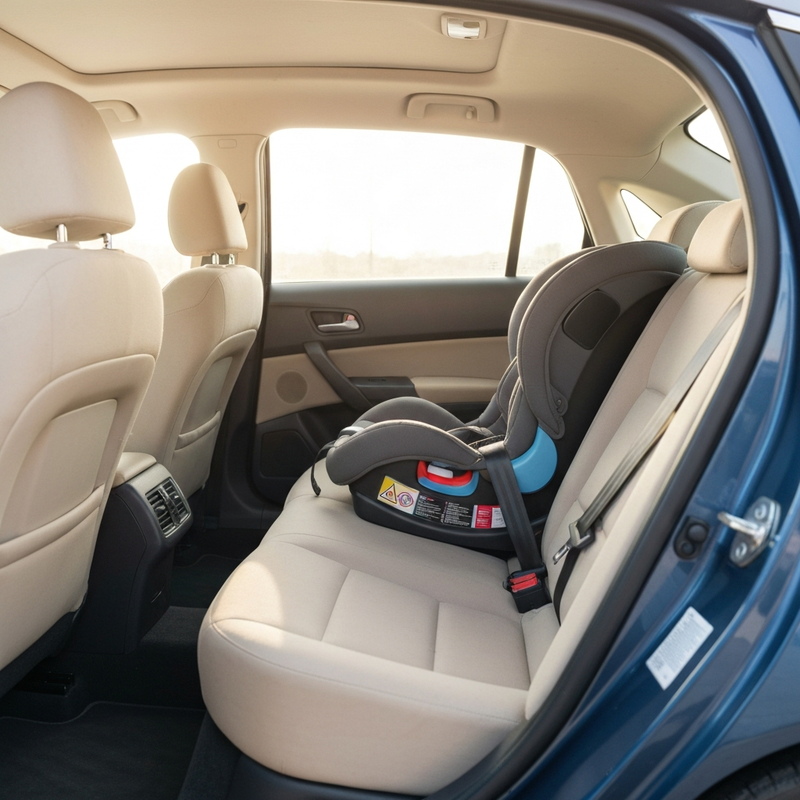
The driver. Whoever is driving is legally responsible for ensuring that every child under 14 in the vehicle is using the correct car seat or seatbelt. If a child is incorrectly restrained, it is the driver who receives the penalty, even if the child is not their own.
This catches out grandparents, friends and others giving a child a lift. If you are driving someone else's child, the responsibility for their restraint is yours, so make sure a suitable seat is fitted before you set off.
The driver is responsible for safe braking regardless of who is on board - our guide to UK stopping distances covers the full Highway Code figures and everything that can increase them.
Driver responsibility extends to the same duty of care on alcohol - our guide to UK drink and drug driving limits explains the specific limits, the testing procedure, and what happens if you are caught.
Can you use a second-hand car seat?
You can, but with real caution. A used seat is only safe if you know its full history, so a hand-me-down from family you trust is very different from an unknown seat bought online. The seat must not have been in a crash, even a minor one, because the damage that weakens it is often invisible.
Check that it has not passed its expiry date, that none of the plastic is cracked or brittle, and that it comes with its original instructions and all its parts. It must also still meet a current approved standard and fit your car and your child correctly. If you cannot confirm the history, the safer choice is a new seat, because in a collision the car seat is the one thing standing between your child and serious injury.
What is the fine for not using the correct car seat?
Failing to use the correct child restraint can bring a fixed penalty, rising to a fine of up to £500 if the case goes to court. As with adult seatbelt offences, it does not carry penalty points on your licence.
The fine, though, is the least of it. The rules exist because correctly restrained children are far less likely to be seriously hurt in a collision, so the real cost of getting it wrong is measured in safety, not pounds.
Frequently asked questions
At what age does a child no longer need a car seat?
A child can stop using a car seat once they reach 135cm in height or turn 12, whichever comes first. After that they may use an adult seatbelt. Below that threshold they need an appropriate seat even if they appear large enough.
When can a child move from a booster to just a seatbelt?
Once they are 135cm tall or 12 years old, whichever is first. Until then, a high-backed booster raises the child so the adult belt sits across the shoulder and hips rather than the neck and stomach, which is what protects them in a crash.
Does a child need a car seat in a taxi?
In a licensed taxi or private hire vehicle, if no correct seat is available, a child aged 3 or over may use the adult rear seatbelt, and a child under 3 may travel without a seat in the rear. Providing a suitable seat is still safer where you can.
Who is legally responsible, the driver or the child's parent?
The driver. Whoever is driving must ensure every child under 14 uses the correct restraint, and the penalty falls on the driver if a child is wrongly restrained, even if the child is not theirs. This is important when giving someone else's child a lift.
What happens if you are caught without the correct car seat?
You can be given a fixed penalty, rising to a fine of up to £500 in court. There are no penalty points for the offence. Limited exceptions apply for licensed taxis and genuine short-notice emergencies, but not for routine journeys.
Temporary insurance quote
Get a price in under 60 seconds!